FAQ
Quick answer for your information needs.
FAQ
Find answers to the most frequently asked questions about PLN's services, rates, and latest innovations.
What is a Tariff Adjustment?
Tariff adjustment is a mechanism for changing and determining the fluctuations in electricity tariffs based on changes in microeconomic factors, so that the tariffs charged to consumers are closer to the Basic Cost of Electricity Supply (BPP).
Will the electricity tariff adjustment take effect on January 1, 2015?
Tariff adjustment is a mechanism for changing and determining the fluctuations in electricity tariffs following changes in microeconomic factors, so that the tariffs charged to consumers are closer to the cost of electricity. Electricity Supply Base (BPP).
Yes, the government implemented tariff adjustments for 12 tariff categories starting January 1, 2015, in accordance with Minister of Energy and Mineral Resources Regulation No. 31 of 2014 dated November 5, 2014, concerning Electricity Tariffs provided by the State-Owned Enterprise (Persero) PT PLN.
In accordance with Minister of Energy and Mineral Resources Regulation No. According to Law No. 9 of 2015, tariff adjustments were applied to household electricity customers with a capacity of 1,300 VA and 2,220 VA starting May 1, 2015. However, considering that these customers had already experienced gradual electricity tariff increases from July 2014 to November 2014, and to ease the economic burden on customers in both categories, the government and PLN postponed the implementation until November 1, 2015, and began implementing them on December 1, 2015.
With the implementation of this tariff adjustment, electricity tariff adjustments are made monthly if there are changes, either increases or decreases, in one or more factors that can affect the basic cost of electricity supply, namely:
- US Dollar exchange rate against the Rupiah (Exchange Rate)
- Indonesian Crude Price (ICP)
- Inflation
Why does the Tariff Adjustment have to be applied every month?
Because electricity supply costs, such as fuel and financial burdens, are affected by changes in exchange rates, the Indonesian Central Credit (ICP), and inflation, which cause the BPP to change, while the government removes subsidies for the twelve tariff groups, these changes are taken into account in the tariff adjustment mechanism.
What is the background to the implementation of the Tariff Adjustment?
- The tariff adjustment is intended to maintain the continuity of electricity supply, improve the quality of service to consumers, increase electrification, and encourage more targeted electricity subsidies.
- The tariff adjustment has received approval from the House of Representatives of the Republic of Indonesia following the results of the Commission VII Working Meeting with the Minister of Energy and Mineral Resources on September 17, 2014.
Are small household customers with 450 VA and 900 VA power also subject to Tariff Adjustment?
Small household consumers with 450 VA and 900 VA power are not subject to the tariff adjustment mechanism
Which tariff groups are subject to the Tariff Adjustment?
There are 12 tariff groups subject to tariff adjustments, all of which reached their economic value in 2014:
- R-1 Tariff, for small households with a power of 1,300 VA
- R-1 Tariff, for small households with a power of 2,200 VA
- R-2 Tariff, for medium-sized households with a power of 3,500 to 4,500 VA 5,500 VA
- R-3 tariff, for large households with power ratings above 6,600 VA
- B-2 tariff, for medium-sized businesses, supplied with low voltage power ratings of 6,600 VA to 200 kVA
- B-3 tariff, for large businesses, supplied with medium voltage power ratings of 200 kVA
- P-1 tariff, for small government offices, supplied with low voltage power ratings of 6,600 VA to 200 kVA
- P-2 tariff, for large government offices, supplied with medium voltage power ratings of 200 kVA
- P-3 tariff, for public street lighting (PJU)
- Category I-3 tariff, for large-scale industries Medium-voltage consumers supplied with medium voltage, with power above 200 kVA. Tariff I-4, namely consumers for large industries supplied with high voltage, with power of 30,000 kVA and above. Special Service Tariffs for low, medium, and high voltage.
Are industries and small businesses subject to the Tariff Adjustment?
Industrial and business consumers Smaller units are not subject to tariff adjustments.
Why was the implementation of the Tariff Adjustment for 1,300 VA and 2,200 VA household customers postponed?
The postponement of the implementation of tariff adjustments for 1300 VA and 2200 VA households was carried out considering that consumers in these tariff groups had experienced gradual electricity rate increases from July 2014 to November 2014. This was also to ease the economic burden on consumers in both tariff groups.
Will customers whose electricity comes from non-fuel power plants also be subject to fuel price adjustments? For example, Java, which predominantly uses coal?
Yes, because the tariff setting regulations apply to all PLN Holding customers everywhere.
Is it permissible for 1,300 VA and 2,200 VA customers to reduce their power to 900 VA?
Tariff adjustments do not prohibit consumers from changing their power. However, reducing power to 900 VA and 450 VA is prohibited. VA by showing the KKS and KPS cards or a certificate from the National Agency for the Protection of Persons with Disabilities (TNP2K)
How is the Tariff Adjustment applied to Prepaid and Postpaid Electricity?
The tariff adjustments for prepaid and postpaid electricity are as follows:
- For prepaid electricity, the tariff adjustment has been in effect for token purchases since January 1, 2015.
- For postpaid electricity, the tariff adjustment has been in effect since kWh usage in January 2015, which will be billed in February 2015.
What is the formula for applying the Tariff Adjustment to the 12 tariff groups?
Formula initial implementation of tariff adjustments for the 12 tariff groups, according to ESDM Ministerial Regulation No. 31 of 2014, is as follows:
TB = TL x (1 + %TA)
Note:
- TB = New Electricity Tariff applicable after the Electricity Tariff Adjustment.
- TL = Old Electricity Tariff applicable based on Regulation of the Minister of Energy and Mineral Resources Number 09 of 2014.
- %TA = Percentage of Electricity Tariff Adjustment.
%TA = % (Kkurs x Δ Kurs) + % (KICP x Δ ICP) + % (Kinflation x Δ Inflation)
Note:
- TA = Tariff Adjustment
- Kkurs = Exchange rate change coefficient.
- Δ Kurs = Difference between the new exchange rate and the reference according to the 2013 State Budget.
- KICP = ICP change coefficient.
- Δ ICP = Difference between the new ICP and the reference according to 2013 State Budget.
- Inflation = Inflation change coefficient.
- Δ Inflation = Difference between new inflation and the reference according to the 2013 State Budget.
How does PLN determine the cut-off point for the rupiah exchange rate against the dollar?
The determination of tariff adjustments in a given month is influenced by the magnitude of macroeconomic realizations for the second month prior to the determination. The regulations can be found in the Minister of Energy and Mineral Resources Regulation Number 31/2014 and Regulation Number 9/2015.
Is the exchange rate used for transactions the selling rate?
The exchange rate used is Bank Indonesia's middle transaction rate
What tariffs are still subsidized?
Tariffs that still receive subsidies in 2015 are:
- S-1 power 220 VA
- S-2 power 450 VA
- S-2 power 900 VA
- S-2 power 1300 VA
- S-2 power 2200 VA
- S-2 power 3500 VA to 200 kVA
- S-3 power above 200 kVA and above
- R-1 power 450 VA
- R-1 power 900 VA
- B-1 power 450 VA
- B-1 power 900 VA
- B-1 power 1300 VA
- B-1 power 2200 VA to 5500 VA
- I-1 power 450 VA
- I-1 power 900 VA
- I-1 power 1300 VA
- I-1 power 2200 VA
- I-1 power 3500 VA to 14 kVA
- I-2 power above 14 kVA to 200 kVA
- P-1 power 450 VA
- P-1 power 900 VA
- P-1 power 1300 VA
- P-1 power 2200 VA to 5500 VA
- Traction power above 200 kVA
- Power supply above 200 kVA
Will subsidized fares not increase in 2015?
There has been no change for the 25 tariff groups that are still subsidized above.
How big Subsidies after the Tariff Adjustment for 12 tariff groups is implemented?
According to the 2015 State Budget, the amount of electricity subsidies is IDR 66 trillion.
How many consumers experienced the Tariff Adjustment?
The number of consumers whose tariff groups are subject to the tariff adjustment mechanism is as follows (data as of October 2015):
R.3 / 6,600 VA and above|
NO |
TARIFF GROUPS |
NUMBER OF CONSUMER |
| 1 | R.1 / 1,300 VA |
7,046,026 |
| 2 | R.1 / 2,200 VA |
2,388,072 |
| 3 | R.2 / > 3,500 to 5,500 VA |
862.282 |
| 4 |
184.104 |
|
| 5 | B.2 / 6,600 to 200 kVA |
488,562 |
| 6 | B.3 / > 200 kVA |
6,660 |
| 7 | I.3 / > 200 kVA |
12,348 |
| 8 | I.4 / 30,000 kVA |
78 |
| 9 | P.1 / 6,600 to 200 kVA |
38,899 |
| 10 | P.2 / > 200 kVA |
1,374 |
| 11 | P.3 |
180,968 |
| Amount |
11,209,373 |
|
Is the I-3 tariff still differentiated between Go Public and Non Public companies?
Starting November 1, 2014, there will no longer be any difference between the I-3 rates for publicly listed companies and Non Go Public.
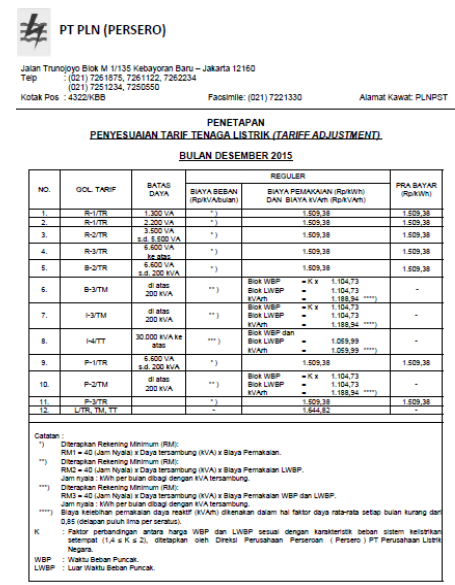
What are the new tariffs resulting from the Tariff Adjustment in December 2015 for the 12 tariff groups?
The tariff adjustments for December 2015 are as follows:
Does the tariff increase improve network reliability?
Yes, of course, PLN must improve its services, including reliability, for consumers who have paid in full according to the BPP. Even without a tariff increase, PLN is always striving to improve network reliability because that is PLN's obligation.
Has the K factor, which differentiates WBP from LWBP, changed?
The K factor has not changed, remaining at 1.5.
Can you provide a simulation of calculating the electricity bill before and after the adjustment?
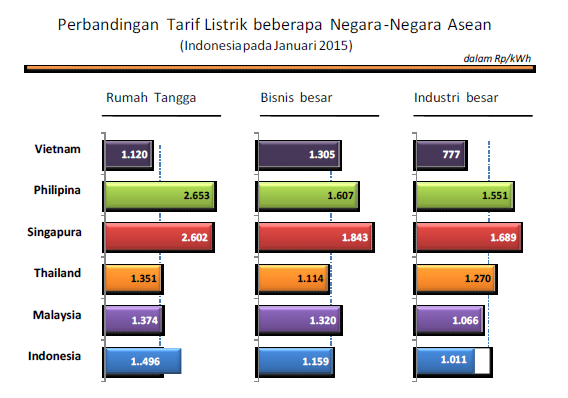
How do PLN's electricity rates compare with those in other countries?
For comparison, electricity tariffs in ASEAN are as follows:
Has the PPJ also changed?
The VAT bill paid by the Consumer changes according to the amount of the Consumer's electricity bill.
What is a Cost? Connection?
Connection Fee (BP) is the fee paid by consumers to obtain an electricity connection or additional power. BP is not intended as a material purchase by Consumers/potential Consumers from PLN.
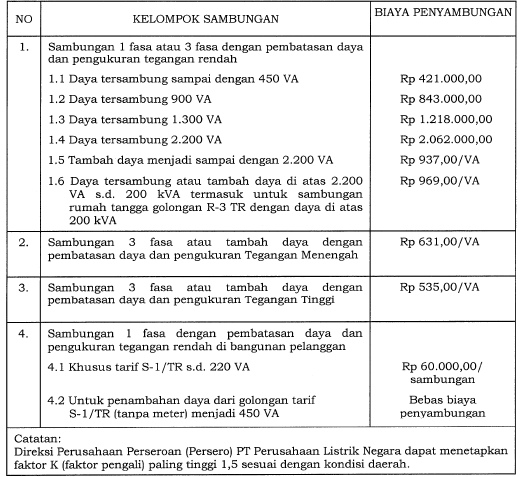
Have BP rates also increased?
Yes, BP rates have changed in accordance with the new BP rates stipulated in ESDM Ministerial Regulation No. 33 of 2014, namely as follows:
Since when have the new BP rates been implemented?
Ministerial Regulation of the Ministry of Energy and Mineral Resources No. 33 of 2014 states that the new BP tariffs will be implemented after the regulation is enacted. The Ministerial Regulation was enacted on November 17, 2014.
So what about BP payments since November 17 that still use the old rates?
Consumers with new installations and additional power who have paid since November 17, 2014, and are still using the old tariff, will be charged a follow-up bill for the difference between the new tariff and the old tariff. The mechanism is as follows:
- Postpaid consumers can pay directly or pay in installments by adding it to their monthly electricity bill starting from February 2015 to June 2015.
- For prepaid consumers, the difference in BP will be billed as a follow-up bill by issuing five registration numbers from February 2015 to June 2015. These five registration numbers for the follow-up bill will be created systemically, and the data will be available at AP2T. This registration number should be communicated to the Consumer by the Unit as soon as possible (January 2015). The Consumer should be informed that if the follow-up bill due in February 2015 is not paid, the purchase of tokens in March 2015 will be blocked. This also applies to follow-up bills for subsequent months.
The Unit must inform the Consumer of any follow-up bill due to BP shortages.
BP shortfalls for postpaid and prepaid consumers must be paid in full no later than June 2015. PLN DIVAGA Headquarters will inform the customer data unit of the BP underpayment and the amount of the BP shortfall.
ESDM Ministerial Regulation No. 33 of 2014 states that there is a K factor of 1.5. What is meant by this K factor?
The K factor is a multiplier used as a multiplier for standard electricity tariffs for certain regional conditions. This applies to new consumers and additional power, where PLN has to pay for the connection to meet certain standards based on local regulations or requests from local governments.
Example:
- Requirement to use underground cables,
- Requirement to use boring machines for cable excavation,
- Requirement for cable excavation depth that passes through vital installations (railroad lines, gas lines, oil pipelines, etc.).
The Board of Directors sets K = 1.5 so BP = standard BP x 1.5
So what about electricity costs outside the provisions above? For example, if the investment costs are much higher than the standard costs
For new connection requests and additional power, consumers only pay the electricity costs as stipulated in ESDM Ministerial Regulation No. 33 of 2014.
Consumers are not charged any additional connection fees. The provisions for implementing new connections and changes in power refer to the Director's Letter No. 0540.161/DIRUT/2013 dated May 22, 2013.
Is it permissible to ask consumers to provide materials to expedite new connections (for example: a 200 kVA transformer for a 197 kVA power plant)?
Not permitted. Consumers only pay the connection fee. The provision of materials up to the APP is the responsibility of PLN. How electricity is provided at the consumer's location is the responsibility of PLN.
Specifically for consumers with a capacity of over 200 kVA, the construction of civil substations on the PLN side is PLN's responsibility, while the land is provided by the consumer under a lease-to-use status by PLN (regulated as B to B in the SPJBTL).
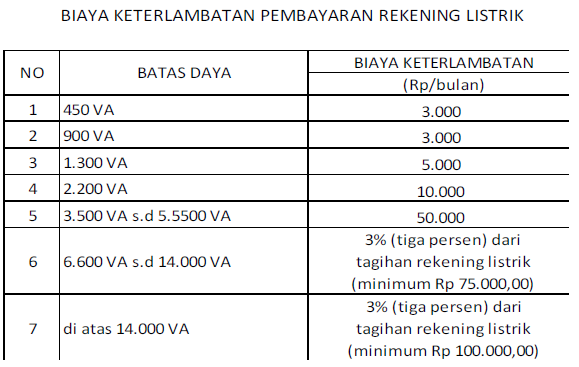
Will PLN also increase the Late Fee (BK)?
Late fees will not increase.
The current BK is:
Are UJL rates increasing?
Currently, the UJL rate has not increased.
Further provisions regarding bank guarantees as a substitute for UJL will be determined further by the Board of Directors.
Currently, UJL rates have not increased.
What is the difference between the Periodic Electricity Tariff (TTLB) and Tariff Adjustment?
Basically, TTLB and Tariff Adjustment are the same: they both adjust the tariff when there are changes in parameters. The only difference is the formula. The TTLB and Tariff Adjustment parameters are different, with the tariff adjustment parameters being simpler.
What is the basis/consideration for applying the Tariff Adjustment to only these 12 tariff groups?
The 12 tariff groups reached economic tariffs on November 1, 2014, which resulted in the government no longer providing electricity subsidies for kWh usage in these 12 tariff groups. If there is a change in the BPP due to changes in the exchange rate, ICP, or inflation, the change will be charged to these 12 tariff groups.
Are the loading costs still applicable?
Load charges still apply for 450 VA and 900 VA power, as well as for Traction tariffs. Consumers outside the 450 VA and 900 VA power categories are subject to a minimum bill of 40 hours of use x contracted power.
What are the benefits of implementing the Tariff Adjustment for PLN?
As is known, consumers subject to tariff adjustments are those no longer subsidized by the government. With the implementation of tariff adjustments, changes in the cost of goods sold (BPP) due to changes in macroeconomic factors will be passed on to consumers. For consumers whose tariffs are still subsidized, if there is a change in the BPP, the cost change will be borne by the government. Thus, the benefit of tariff adjustments reduces dependence on government subsidies.
What are the benefits of implementing tariff adjustments for consumers?
Consumers pay electricity rates according to PLN's actual production costs based on the macroeconomic conditions that influence them. If the BPP decreases, the tariff will also decrease.
How much revenue will PLN receive with the implementation of the Tariff Adjustment for 1,300 VA and 2,200 VA power?
In budget calculations PLN's income in 2015, if tariff adjustment is applied to 1,300 VA & 2,200 VA, PLN will generate additional revenue from consumers of approximately IDR 300 billion per month.
What is the authority of the PLN board of directors in determining tariff adjustments?
According to Ministerial Regulation No. 31/2014, the PLN Board of Directors is authorized to add a K coefficient when determining tariff adjustments.